A laundry stain-removal FAQ should explain what the shop needs to inspect, what its standard process includes, and when a customer will hear whether treatment is possible. Do not promise that every mark will disappear. Publish the process you can stand behind; let a person examine the garment before making a promise about its result.
Someone brings a pale shirt to the laundry. There is a dark patch on its cuff. “Can you get this out?” is a reasonable question, but a photograph in a chat cannot tell the cleaner what the fabric label says or what was rubbed into the patch last night. A useful stain-removal FAQ tells people what happens at the counter and what the shop still has to examine. This template is a set of prompts for the owner to complete, not a promise about a particular shirt.
What should a customer bring or disclose with a stained item?
Invite the customer to point out each affected area. A little mark under a collar is easily missed if the handover record just says “stained shirt.” Ask what spilled if they know, how long ago they noticed it, and whether they used heat, water or a home product afterward. Do not make identification of the substance a condition of speaking to the shop: often the customer simply does not know.
Have staff distinguish observed from reported. “Brown patch on left cuff” is an observation. “Coffee spilled on Tuesday” is the owner's account. That distinction matters when deciding what can actually be inspected. If your shop keeps a photo or sketch of the marked area, say so in its intake practice; never publish a customer's image or receipt on an FAQ page.
Also ask customers to leave the garment's care label intact where possible. If the label is missing or unreadable, your completed answer should say who decides whether the item can be assessed. A public list of stain types cannot substitute for looking at the actual cloth, trim, lining and existing wear.
What can the laundry stain-removal FAQ say?
Complete these four answers with the person who handles garments. The bracketed instructions are not ready to paste onto a public site.
Do I need to tell you what made the mark? Please point out [how your shop identifies affected areas at handover]. Tell us anything you know about [the source of the mark, when it appeared and any home treatment]. It is okay if the source is unknown; [describe the next inspection step your team actually takes].
Can you remove every stain? [State how your cleaner checks the garment and decides which methods, if any, are suitable.] An inspection and an attempt are different from a promise that a mark will disappear. [Explain when the customer hears the decision.]
What will I pay if treatment does not work? [Explain separately any inspection cost, cleaning charge and charge for an attempted treatment.] [Say when the customer authorizes each charge.] Do not leave a customer to infer that an unsuccessful attempt is free, or that a drop-off authorizes every extra service.
What if I disagree with the result? [Give the actual route for reviewing the garment with a person.] [Explain the shop's approved rule about a repeat attempt, refund or other remedy, if one exists.] Do not fill this line from another shop's policy.
Before publishing, ask the counter worker to act out the exact point at which the item is accepted, examined, and cleared for treatment. Those are different moments. The website should not turn “we can take a look” into “we will clean it,” or “we will try” into “it will be spotless.”
When does a stain question become an inspection request?
A person might ask whether the laundry checks care labels. If the shop has written down its usual procedure, the website can answer that process question. But “Will my silk blouse be spotless by Friday?” combines fabric suitability, an unseen mark and a deadline. None follows from the general procedure.
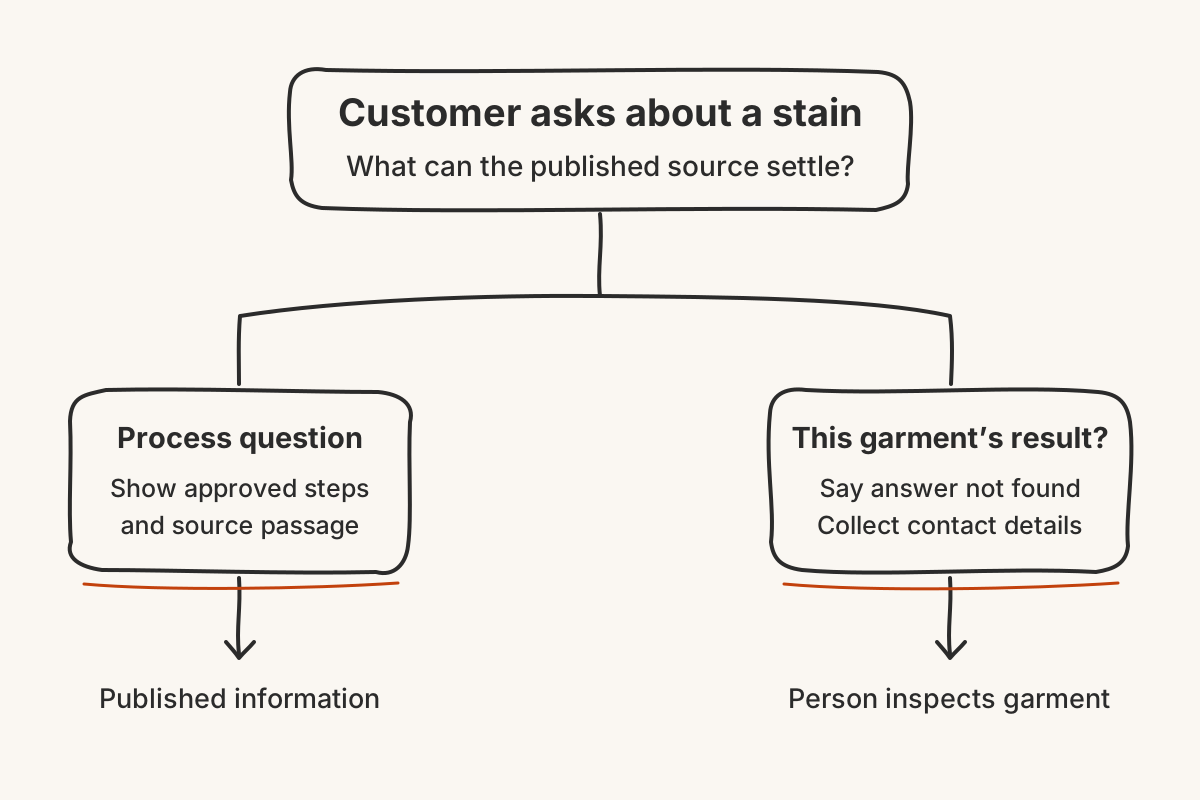
Chatterbox answers from material the business supplies: a crawled page, file, pasted text or hand-typed Q&A. It shows a source passage. If that material does not settle the visitor's particular question, it says it cannot find the answer and asks for name, phone and email. The lead goes to the dashboard and by email for someone to review. No fabric is inspected by the widget. For a time-sensitive garment, publish a direct contact route your own staff monitors instead of making a customer wait for a callback.
How can the counter team test the wording?
Put an ordinary cotton shirt and a delicate garment on the counter. Give each a different marked area, then ask a colleague who did not draft the FAQ to read it aloud as if both owners had walked in. Can they tell what information to collect without declaring either stain removable? Can they explain what is payable before touching the item? If not, the missing decision belongs in the shop's real policy, not in improvised chatbot copy.
Finally, test the website with the process question and the silk-blouse question. Check whether the process reply points back to the approved passage; the individual outcome needs a person. When the shop changes how it seeks consent or describes an unsuccessful attempt, replace the old source text. A website source can be re-crawled once a day. The goal is a customer who knows what to bring and what remains undecided, not a guarantee the laundry cannot honestly give.