A chatbot answers from what your website already says, so publish the answers first. Write down the twenty questions customers actually ask, check that each one has a real answer somewhere on the site, and delete the pages that contradict each other. Then install it.
Installing Chatterbox takes one script tag. Getting good answers out of it takes an afternoon with your own website, and that afternoon is the part nobody schedules.
The bot answers from material your business has published. If the answer to a common question is not written down anywhere, the bot will not have it either, and it will say so rather than guess. That is the right behavior, and still a disappointing conversation for the customer who asked.
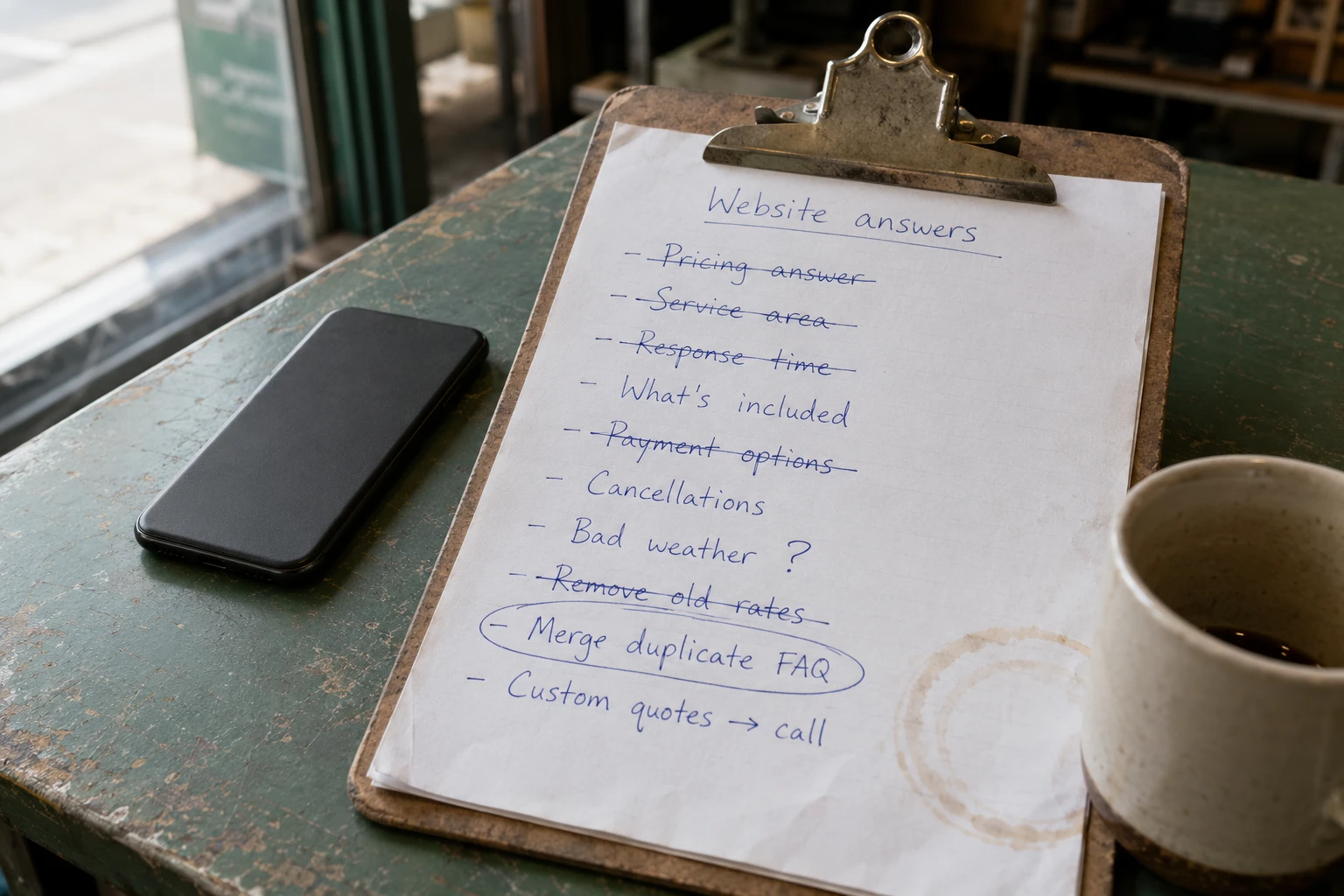
Write the twenty questions down first
Not the questions you think a customer should ask. The ones in your inbox and on your phone this month.
Open the last fifty messages your business received and list what people actually wanted to know. Most small businesses find the same shape: what does it cost, do you cover my area, how soon can you come, what does the price include, do I need to be home, what happens if it rains, how do I pay, what if I need to cancel.
Twenty is enough to start. Write them as the customer typed them, misspellings and all, not as a heading you would put on a page.
Check each question has an answer that exists
Go down the list and find the sentence on your website that answers each one. Not the page that is roughly about the topic — the sentence.
You will find three kinds of gap. Questions with a clear published answer, which are done. Questions where the answer is in your head and has never been written anywhere, which are the afternoon's real work. And questions where the answer is on the site but hedged into uselessness: "pricing varies depending on requirements" answers nothing, and a bot repeating it back at eleven at night has wasted the visitor's time.
Fix the middle group by writing two or three plain sentences per question. That is all it takes. A short honest answer beats a polished paragraph that dodges.
The answers Indian businesses almost never publish
Some gaps show up on nearly every site, because the owner answers them on the phone so often that they have stopped registering as questions.
Whether the price includes GST, and whether a proper tax invoice comes with it. Which pin codes or sectors you actually serve, rather than "Tricity and surrounding areas". What you accept: UPI, card, cash on delivery, bank transfer, EMI. Your real timings, including Sundays, and which holidays you close. What your warranty or return window is and who pays for the return trip. Whether an advance is needed, how much, and whether it is refundable.
Write these six down even if none of your competitors have. They are the difference between a bot that answers a buying question and one that keeps asking for a phone number.
Delete the contradictions before you add anything

More pages is not more knowledge, and this is where it goes wrong at scale.
One crawl of a customer site read more than 1,000 pages and produced over 5,400 question-and-answer pairs. Most were near-duplicates: the same pricing language repeated across dozens of location pages with a word changed here and there. Volume like that does not make a bot better informed. It makes a pile of slightly different answers to the same question, and something has to reduce it back down to the one answer that is true. A crawl audit is how you see that pile before your customers do.
So before you install anything, look for the places where your own site disagrees with itself. An old service page with last year's rates. A callout promising same-day response that a later page contradicts. Two FAQ sections written eighteen months apart. Delete or update them. Every one you leave behind is a wrong answer waiting to be given confidently.
Decide what you do not want answered
Some questions should reach a person. Custom quotes, unusual jobs, complaints, anything where the honest answer is "it depends on seeing it".
Decide which those are in advance, and make sure the material you hand over does not accidentally cover them with a standard rate. A published figure stretched to cover a job it was never meant for reads to the customer as a promise, and you either honor it at a loss or explain why it was wrong. Both cost more than the enquiry was worth.
For those questions, the useful outcome is a name and a number, not an answer.
What good looks like when you switch it on
Every question on your list has one findable answer on the site, written plainly. Nothing on the site contradicts anything else on the site. The three or four questions that need you are handled by collecting contact details instead of quoting a number.
That is a working knowledge base. It is also just a better website, which is why the afternoon is worth spending whether you install a chatbot or not.
When it is done, put the widget on the site and ask it the twenty questions yourself before a customer does.