A salon patch-test FAQ should say which services your rule covers, when and how the test is arranged, who checks the result, and what happens if a client cannot complete it. Use your salon's approved process rather than a borrowed waiting period. A website answer can explain the rule; staff must decide what it means for an individual appointment.

A salon patch-test FAQ should say which services your rule covers, when and how the test is arranged, who checks the result, and what happens if a client cannot complete it. Use your salon's approved process rather than a borrowed waiting period. A website answer can explain the rule; staff must decide what it means for an individual appointment.
Imagine a client has booked color for Friday. On Wednesday they remember a test performed at a different salon last year. Is that enough? The website cannot decide by looking at a calendar or by borrowing another salon's policy. It needs to give the client a route to the person responsible for the treatment. The five-question draft below is deliberately incomplete until your color team fills it in.
Does the rule change between color services?
Draw up a service-by-service sheet before writing customer copy. In one column put the exact name a visitor sees when enquiring; beside it put the test requirement your color team has approved, including any conditions for first visits, changes in products or time since the last visit. Leave a cell blank when nobody has settled it. That blank is a question for the team, not permission to assume the answer is no.
Where a test involves a separate visit, distinguish the visit from the subsequent color appointment. A client who comes in to arrange a test may have neither completed the process nor been cleared for treatment. A salon whose policy uses a time interval should specify what event starts that interval and who checks it. Do not supply a duration from a blog post or say that previous treatment elsewhere is equivalent to following this salon's process.
What should the salon patch-test FAQ actually say?
Use this block as a set of decisions to fill, not text to publish with square brackets still in it. Get the final version signed off by whoever performs the service.
Will I need a test for [service name]? For [the precise service and client circumstances], our rule is [approved requirement]. For a different service, ask the color team before assuming the same rule applies.
Can I use a result from elsewhere? [Your team's actual position on an earlier test, including any product or time conditions.] Please tell us where and when it happened; we will check what applies to the service planned here.
How do I arrange the required visit? Contact [a route monitored by the color team] and mention [service and details needed to identify the request]. We will explain [the verified sequence for attending, recording and reviewing the test].
What if I notice a reaction or miss the test? Contact [the route to a person] before attending for color. [State the team's approved next step, separately for a reaction and for an incomplete test.] This website cannot decide whether to proceed with treatment.
When is the color visit confirmed? [The person or role responsible] checks [what your salon actually checks] and confirms [the next step through the route your team uses]. An online question is not clearance to proceed.
If the salon cannot yet answer the earlier-test question, remove that response and ask staff to decide its policy. A vague “usually fine” is worse than a clear request to contact the team, because a client may travel expecting treatment on its strength. Likewise, do not name a number of days until the relevant product instructions and the salon's practice have been checked by the color professional.
Which test question cannot be settled online?
“How do I arrange the test for a root tint?” asks about a standard process. “My skin reacted yesterday; can you do my appointment tomorrow?” asks for judgment about one person. A fact about the first does not settle the second. A visitor's symptom report should not be converted into a diagnosis, reassurance or approval by any website FAQ.
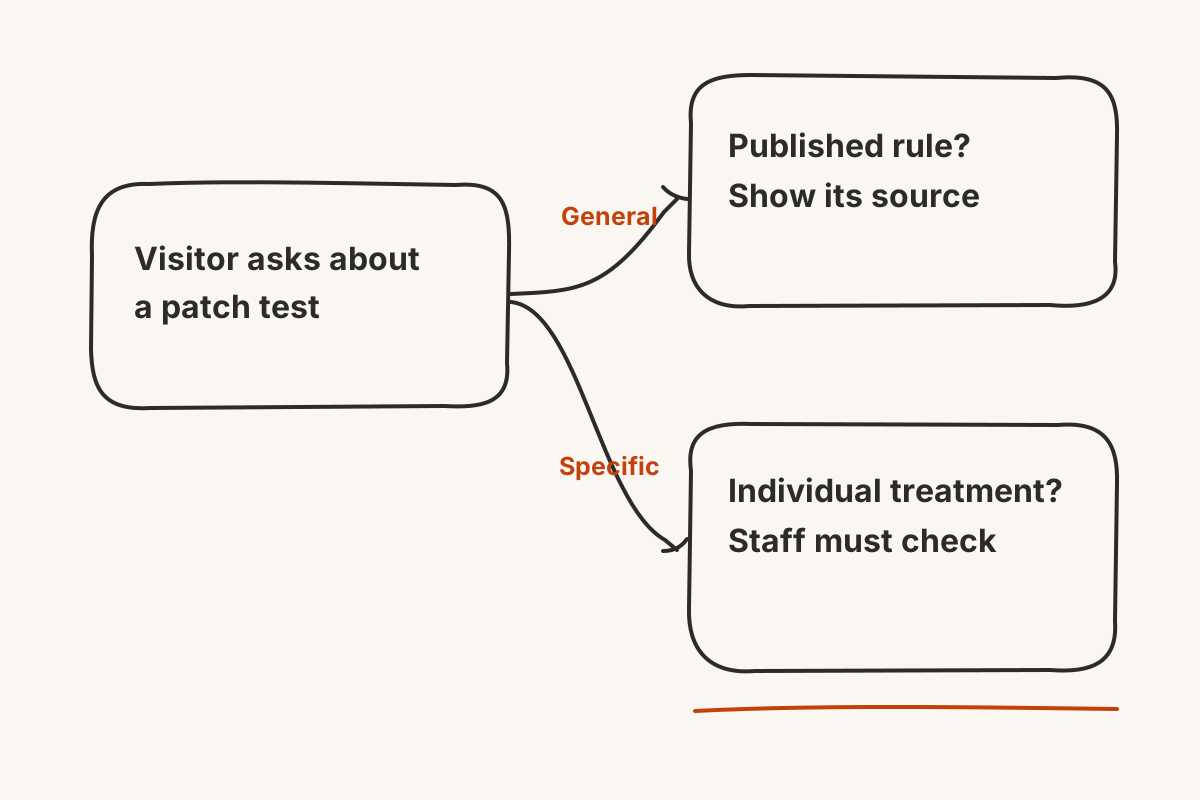
Chatterbox uses the business's own site crawl, files, pasted text and hand-typed Q&A to answer questions; visitors can see the source passage. When the information supplied cannot resolve a question, the widget says it cannot find an answer and asks for name, phone and email. That enquiry reaches the dashboard and by email. It is not a medical triage, a live conversation with a stylist or a booked color session. Make the salon's monitored route prominent for a client who needs a timely decision. Someone on staff, not the widget, must check their case.
Can a new client follow the instructions without guessing?
Give the finished FAQ to a receptionist and a colorist separately. Ask each to talk through the Wednesday-to-Friday example: is the other salon's test relevant, how does this client reach someone, which visit comes first, and who confirms Friday? Differences in their accounts mean the public instructions are not ready. Check whether the same words still work if the client switches from one color service to another.
Finally ask the widget about the ordinary procedure and inspect its cited passage. Then ask whether a particular reported reaction allows treatment. The answer to the second cannot be a confident yes assembled from a general rule. If your salon changes its procedure, correct the maintained source, retire contradictory copies and re-test; Chatterbox allows one re-crawl per source each day. A useful FAQ gets a client to the right person before travel, not past a decision that only staff can make.