A salon late-arrival policy FAQ should tell clients when to notify the salon, whether a shorter service is possible, who decides if the appointment must move, and what happens to any fee or deposit. Publish only the rules your team has approved. A website chatbot can repeat the policy, but a person must confirm what can happen with today's slot.

The client booked a color service and is stuck on the road. The next client will need the same chair soon. A message saying “I'm nearly there” does not establish whether the stylist can finish safely, whether the appointment should become a shorter service, or whether a deposit carries over. A useful FAQ names the ground rules without turning a moving timetable into a fixed promise.
This is a blank framework. Agree on the salon's real decisions with the people who schedule and perform each service before replacing the brackets. A haircut, a consultation and a multi-stage color treatment need not share one cutoff.
Who handles the call from a client running late?
Pick the channel somebody watches during booked sessions. A phone answered at reception may be useful; a social inbox checked after closing is not. Ask the client for the booked service, start time and likely arrival. Let staff find the appointment without requiring the client to explain the traffic or send personal information into a public chat.
Make the immediate instruction explicit: contact the salon before deciding to travel on. Reception can examine the remaining chair time and speak to the stylist. The website cannot see those facts. An unread message should never be mistaken for a confirmed adjustment. If your salon does not take calls while serving clients, publish the route it actually monitors, even if that route is less convenient.
What should a salon late-arrival FAQ say?
Use these five questions, but choose your own answers. Remove any choice the salon has not approved.
I may be late. Where do I reach you? Contact [the monitored route] with [appointment start], [booked service] and [estimated arrival]. A message alone does not change the booking.
When can you still see me? For [specific service], we apply [actual boundary and the event from which it is measured]. After that, [staff's genuine next step]. [Name any service with a different rule.]
Could we do less work in the remaining time? [Describe whether a shorter option exists and which staff member agrees to it.] [Explain when the client hears the revised price, if the price changes.]
What happens to my advance? [State the salon's deposit or fee rule, its trigger, and whether notice changes it.] An individual dispute is reviewed through [real route].
May I choose a different day? [State how the team checks another opening and confirms it.] Asking does not reserve another chair.
Notice what each line does not do. It does not give a generic grace period borrowed from a different shop. It does not promise a partial service for a treatment that cannot be cut short. And it does not say “fees may apply” without explaining when and to which booking. Get the fee and deposit language checked against your actual terms and applicable consumer rules.
Which decision belongs with the stylist, not the FAQ?
A policy can say that clients should notify reception and explain the rule for a named service. Whether there is enough chair time now depends on the work planned, the client's arrival and the next appointment. Even if a general grace period applies, a color treatment cannot be approved merely by subtracting minutes on a web page.
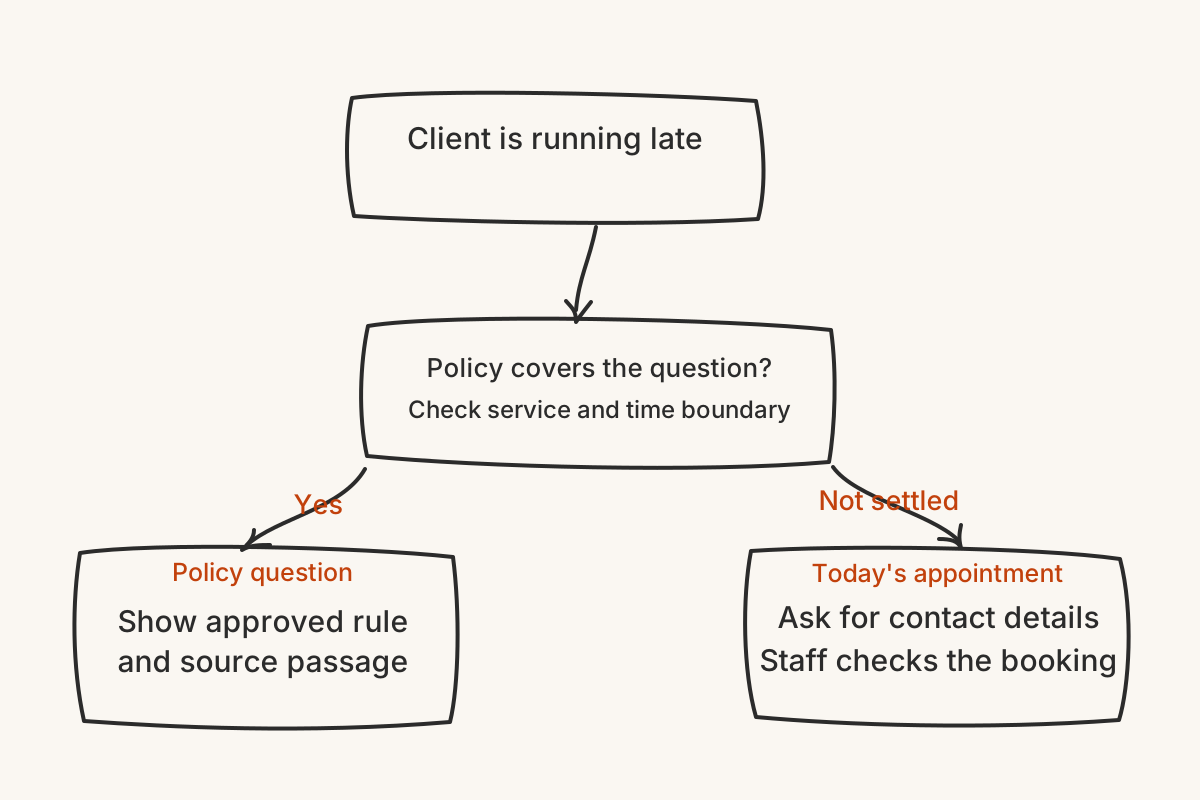
Chatterbox can repeat approved wording from a crawled page, uploaded file, pasted text or manually entered Q&A. It displays the source passage. Keep the service name beside its time rule so the excerpt cannot sound universal. If the supplied material does not resolve an individual late arrival, it says it cannot find the answer and requests name, phone and email. That enquiry reaches the dashboard and by email for a person; the widget does not move appointments or call clients. A traveler needing a decision immediately should use the salon's monitored contact route, not wait for that handoff.
How can the salon test its wording before it goes live?
Role-play three calls with reception. One client is late for a trim; one is late for a long color appointment; one wants to change both the service and the time. Can staff tell which rule applies without inventing a cutoff? Can they tell when the stylist needs to decide? If the FAQ suggests the same outcome for all three, split the wording by service.
Ask the website chatbot for the general late-arrival rule and inspect the passage shown with its reply. Then ask whether a specific client can keep today's slot when the page has no live diary information. A made-up yes, price or fee waiver would be wrong; the unanswered case needs a person. When the salon revises the rule, retire old versions and refresh the website source after the new words are live. Chatterbox allows one re-crawl per source each day. The useful outcome is not fewer calls at any cost. It is fewer clients arriving on the strength of a promise nobody made.