An appointment rescheduling policy should tell customers how to request a change, when notice is due, what happens to any advance payment, and who confirms the new time. Publish the standard rule without implying that a requested slot is reserved. Leave unusual cases for a person to decide.

Tuesday evening: a customer with a Thursday haircut wants Saturday instead. The receptionist hasn't looked at Saturday's diary. What should the website say now? It can tell the customer where to send a request and when they will hear back. It cannot sell a Saturday chair that no one checked.
The text below is a drafting frame for an appointment-based business. The bracketed fields are decisions for your team, not terms to paste unchanged.
Does the same rescheduling rule fit every service?
Walk through a working day before drafting the public rule. A quick trim might fill a short opening. A long color visit blocks a chair and a stylist for considerably longer. Two linked sessions might require the same person on separate days. Decide which bookings share a process and which deserve a separate explanation.
Now choose a real notice cutoff. “At least a day ahead” can mean several things to someone writing on a Sunday when the shop is closed. Specify the point from which you count and a contact route a staff member actually monitors. If a message outside opening hours counts as received when sent or when read, the business needs to decide that too. The website should not leave it to the customer to guess.
Finally, ask what the receptionist does with the original booking while a different time is sought. Is it held, released immediately, or released only after the replacement is accepted? That operational choice belongs in the customer's wording. Otherwise a polite “we'll see what is free” can leave two people with opposite ideas of what Thursday means.
What wording belongs in the policy?
Complete this short block with the decisions your business has made. Remove choices that do not apply, and have the person who manages the diary read the finished version aloud.
Changing your [service] appointment
Please contact [the monitored phone, email, or other route] by [the precise notice cutoff]. Include [the identifying information needed to locate the booking] and [your preferred replacement times].
We will check the diary for [the same service and staff member, or the alternatives your business actually offers]. Your suggested time is a request, not a reservation. Your current booking [say exactly when and how it is held or released].
We will confirm the agreed service, date, time and location through [your actual confirmation method]. Until you receive that confirmation, please do not assume the new appointment has been made.
If an advance was paid, [state only the approved date-change treatment and link to the complete payment terms]. If we need to move your booking, [state the separate process the business follows].
A customer might prefer an earlier Saturday slot, then accept a Tuesday evening offer. The message confirming Tuesday should identify Tuesday, not merely say “done.” Keep a record of the customer's request and of the agreed replacement. If Tuesday is only an offer awaiting acceptance, call it an offer; if it expires, give the actual expiry only if staff can honor it consistently.
Who can promise a replacement time?
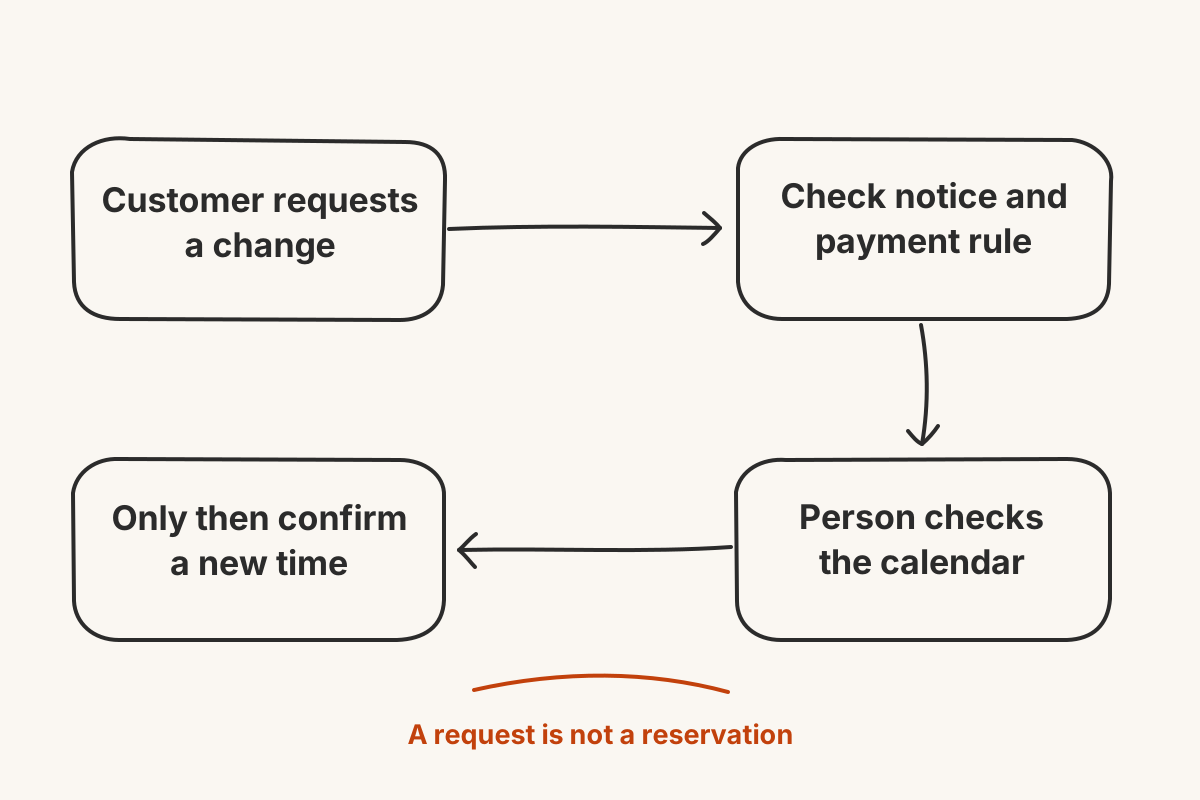
The sequence is Customer requests a change → Check notice and payment rule → Person checks the calendar → Only then confirm a new time. A request is not a reservation. The request, the staff member's offer and the customer's acceptance are separate events. That distinction is easy to lose in a short online exchange.
A customer may want the same stylist at a busier time, switch from a cut to color, or keep one part of a two-part visit. The shop has to see which staff, chairs and service durations are actually free. Neither the notice rule nor an earlier advance proves that a particular combination is available. Leave the decision with the person holding the booking book.
Chatterbox can answer from a business's site crawl, uploaded file, pasted text or hand-typed Q&A. It shows the source passage with an answer. If those materials do not settle a visitor's individual scheduling request, it says it cannot find the answer and asks for name, phone and email; the lead reaches the dashboard and by email. The widget captures the question for staff. It does not place a call or reserve a chair.
Can a customer tell what is still booked?
Run a dry rehearsal with two cards: one says Thursday haircut, confirmed; the other says Saturday haircut, requested. Hand your finished website text to someone unfamiliar with the diary. Ask them which card they may safely act on. If they think Saturday is confirmed, fix the sentence that led them there.
Next offer a different time and ask what happens to Thursday if the customer declines. Then change the service. Does the wording still make sense when a longer visit requires another stylist? These small trials reveal the practical gaps much faster than asking whether the policy “sounds clear.”
Test the website widget with a question about the stated notice cutoff, then with a request for a particular open chair. Check the source passage for the rule. A requested chair whose availability is absent from the source should go to a person, not be described as booked. When the business changes the cutoff or confirmation method, update the maintained source and remove old copies. Chatterbox allows a website source to be re-crawled once a day. The policy has succeeded when a visitor knows how to ask and knows not to travel until the new visit is confirmed.