A minimum order quantity FAQ should state the smallest standard order, the product or variation it applies to, whether samples are available, and which lower quantities need a separate quote. Chatterbox can surface those published rules and collect contact details when a buyer's request still needs a person to decide.

A minimum order quantity FAQ should tell a buyer the smallest standard order and where that rule stops. The useful answer includes the product, variation, unit, and any sample option. A request below the published minimum may still be worth discussing, but it should not receive an automatic yes or an invented surcharge.
Replace every bracketed instruction below with a rule your business has approved. Delete any line that does not apply.
What should the minimum order answer include?
Start with one complete sentence:
The minimum order for [named product] is [quantity] [pieces, packs, kilograms, meters, or another unit] per [design, color, size, delivery, or order].
The unit matters. “MOQ 50” does not tell a buyer whether fifty mixed items count, whether every color needs fifty, or whether the number applies to one design. Keep the condition beside the number.
If different products have different minimums, publish a small list rather than one broad rule:
[Product A]: [quantity and unit] per [condition].
[Product B]: [quantity and unit] per [condition].
[Custom work]: reviewed after [the details your team needs].
Name what is included in the standard order. Packaging, setup, customization, delivery, and tax are separate questions unless your approved terms place them inside the quantity rule.
How should you explain samples and mixed variations?
A buyer asking for two pieces may be testing quality rather than placing a small production order. State whether a sample route exists without making it sound like the ordinary minimum has disappeared.
Samples are [available / not available] for [named products]. A sample [does / does not] use the same price, finish, customization, and delivery terms as a standard order.
Then settle the mixing question:
The minimum may be split across [approved colors, sizes, or variations] only when [condition]. Each [design or other fixed element] still requires at least [quantity and unit].
Do not use “mix and match available” if the workshop still needs a minimum run for each design. A buyer will reasonably read the shorter line as permission to combine everything.
What should happen below the published minimum?
Choose the answer that reflects what the business actually does:
We do not accept orders below [quantity] for [scope].
or
Requests below [quantity] are reviewed individually. Please share [product, quantity, variation, delivery place, and required date] so the team can check what is possible.
The second version is an invitation to ask, not a promise that the order will be accepted. Do not publish a likely surcharge unless the team applies the same formula consistently. Material availability, setup work, production schedule, and delivery may make two small requests different.
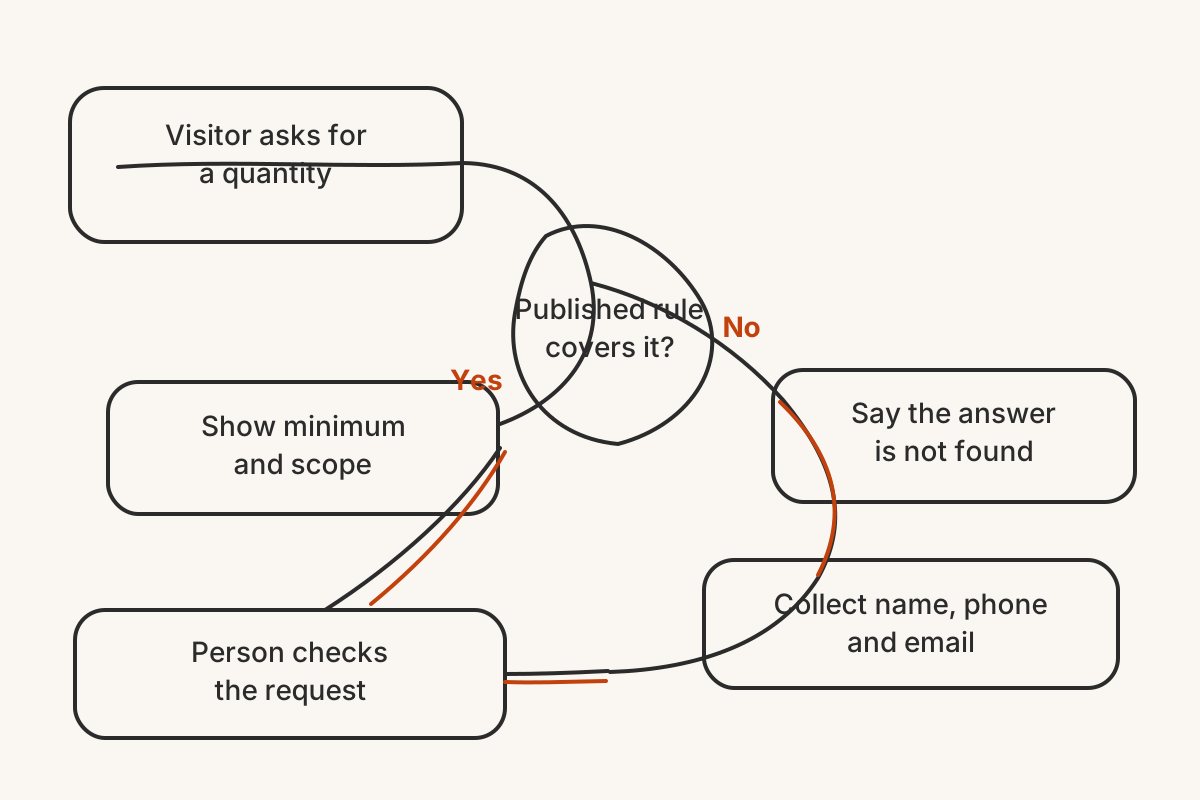
Chatterbox answers from a site crawl, uploaded file, pasted text, or hand-typed Q&A. It shows the source passage behind each answer. When the supplied material does not settle a below-minimum request, Chatterbox says it cannot find the answer and asks for a name, phone number, and email. The lead reaches the dashboard and by email for a person to review.
The decision path is: Visitor asks for a quantity. Published rule covers it? Show minimum and scope. Say the answer is not found. Collect name, phone and email. Person checks the request.
How do you test an MOQ FAQ before publishing?
Ask about the exact standard quantity first. Confirm that the answer keeps the unit and condition attached. Then test a mixed order: change the color, size, or design in a way the FAQ either permits or does not mention.
Finally, ask for one unit below the minimum. If the page states a firm refusal, the answer should preserve it. If the page says smaller requests are reviewed, the reply should not approve the order. If no published rule settles the case, contact capture is the honest result.
Keep the minimum in one maintained source. When the quantity, sample rule, or mixing condition changes, remove stale copies and update the primary page. A website source can be re-crawled in Chatterbox once a day. Re-test the standard order and the below-minimum request after refreshing it.
A useful MOQ FAQ gives a buyer enough detail to qualify an ordinary order. It leaves the exception with someone who can inspect the actual request.