A home service call-out fee FAQ should separate the cost of sending someone to the customer's address from inspection, parts, and repair. State the covered area, when the visit charge becomes payable, and what happens if access or cancellation changes the trip. Publish your actual terms; leave job-specific prices to the team.

The washing machine is leaking, and the customer cannot bring it to the workshop. They want to know the cost of getting a technician to their flat, not the eventual cost of a new part. A home service call-out fee FAQ is a map of the trip and its conditions. It should make the first charge understandable before a booking is accepted. The sample wording here has blanks because only your business can set those terms.
How do you describe the trip without pricing the repair?
Start with the geographical boundary. A named neighborhood, a postcode list, or a measured travel band gives the visitor something to check against their address. “Local visits available” does not. If your technician crosses a toll or travels beyond the usual radius, decide who confirms the different charge and at what stage. Do not publish a universal price that the team routinely has to change after hearing the location.
Next, identify the unit on the bill. Is it one visit to one address? Would a second appliance in the same kitchen mean another attendance charge, or only a separate assessment charge? Does a return journey for a part count as a new visit? These are not questions a generic price tag can resolve. Where your policy has no fixed answer, explain how the team confirms the scope before the visit is booked.
Distinguish travel from the fault-finding work that follows. A business might bundle them or charge separately. The FAQ needs the actual arrangement, not a suggested industry norm. In particular, someone should not read a trip fee and conclude that it buys a working washing machine. Keep any part or repair estimate out of the visit-fee sentence.
What can you put in the visit-charge FAQ today?
Fill these lines from your current policy. Remove a line if the shop cannot stand behind it. The bracketed alternatives are editorial prompts, not words to paste onto the public page.
- Where do you visit? We visit [actual neighborhoods or travel band]. For [addresses outside that boundary], please [method for getting a confirmed visit charge] before booking.
- What is the call-out charge? The charge is [approved amount or formula] for [one address, one visit, or the unit you use]. It includes [specific attendance or assessment work].
- Will it cover another appliance? If there is a second item at the same address, [your rule on extra inspection or attendance charges]. Tell us about it [at the stage you require].
- What happens after an inspection? Work beyond [included scope] is [how it is quoted]. We wait for [the customer approval your shop requires] before starting that work.
- Can I cancel? If you cancel [before the cutoff your business has approved], [the actual charge outcome]. A later cancellation follows [your approved rule].
- What if the technician cannot get in? If access is unavailable at the agreed location and time, [your actual fee and rescheduling rule]. For a locked building, tell us [the access information you need before arrival].
The last two lines deserve a staff conversation before they go online. A missed visit can involve a blocked road, a wrong address, or an unattended gate. Your policy may treat those differently. A fill-in-the-blank example cannot decide whose fault a real missed appointment was. State the standard rule and reserve disputed cases for someone who can check the booking details.
When should the team take over a visit-fee question?
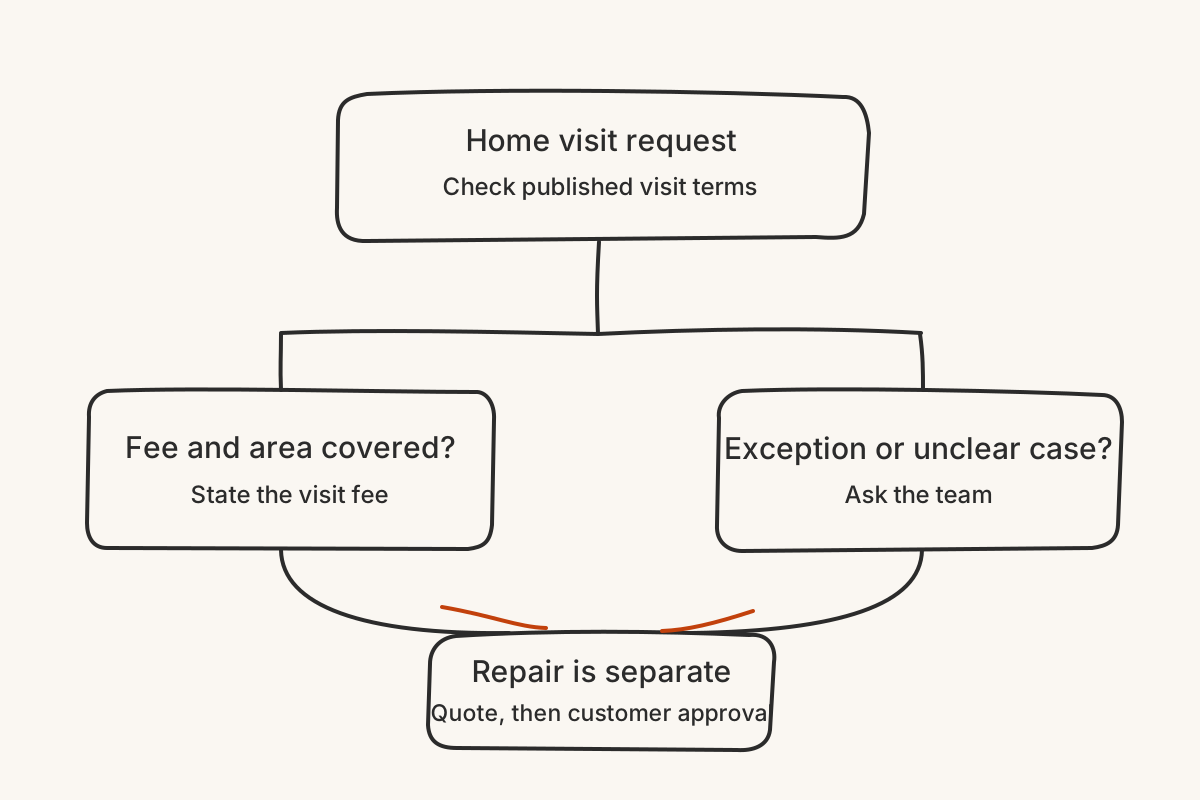
A useful path is Home visit request followed by Check published visit terms. For Fee and area covered?, State the visit fee. For Exception or unclear case?, Ask the team. Later, Repair is separate: Quote, then customer approval. This is a decision boundary, not a picture of a chat interface.
Before using the FAQ, try it against three plausible enquiries: an address inside the ordinary area, a customer with two machines, and a resident who will not be home to open the gate. Can the first be answered from the page without qualification? Does the second depend on a rule you have actually written down? Does the third require the team to resolve an exception? Revise the page until those boundaries are visible to the reader.
Chatterbox uses a business's own material to answer visitor questions and shows the passage it used. If there is no answer in that material, it says so and asks for contact details. Name, phone, and email enquiries reach the dashboard and by email for staff to follow up. It does not send a technician, negotiate a fee, or approve a repair. Update the source when the travel boundary or charge changes; a stale area list makes a correct-looking answer wrong for the next caller.