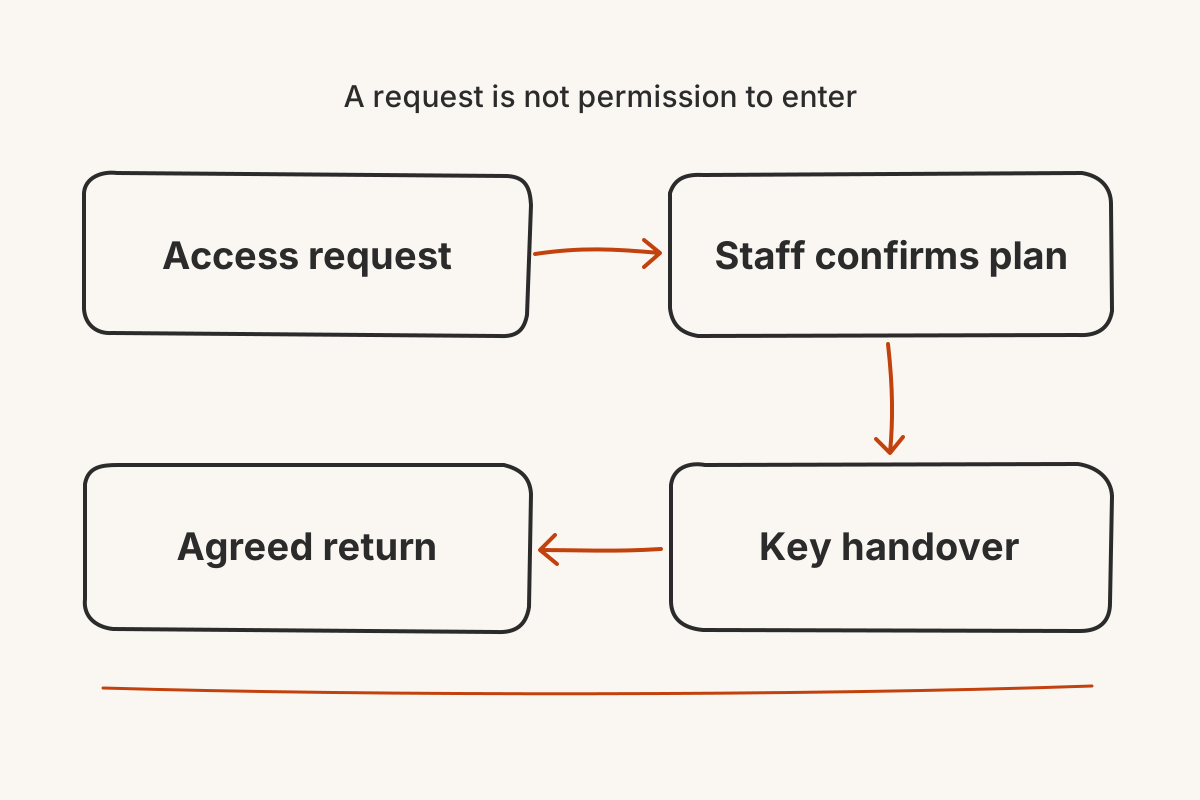
A home cleaning key handover FAQ should explain whether an unattended visit is possible, how an access arrangement is confirmed, who may receive a key, and how it comes back. Keep door codes and addresses out of a public FAQ. A request for unattended access is not permission to enter; a person must confirm the specific plan.
Use this home cleaning key handover FAQ template to agree how your cleaner unlocks the front door and secures the house after the job. Fill the brackets with your procedures. Keep addresses, key-safe locations and credentials in private client records.
Cleaning an empty home
Get the client's permission for the assigned cleaner to enter during the appointment window. Check access through communal gates and intercoms as well as the front door.
Can I go out during my clean? We accept [your unattended-visit terms]. Arrange entry with [access coordinator] by [cutoff]. Tell us about building restrictions through [private contact channel]. Our coordinator will confirm the appointment's entry plan with you.
State the cleaner's waiting time and missed-access fee, using your booking terms. At a locked door, the cleaner should phone the designated contact. Prohibit entry with a passerby's help.
Spare keys and named holders
Decide whether you hold a spare between appointments or collect one for each clean. Record the number of keys received and identify the employee responsible for custody. Use an internal reference on the tag; omit the client's address. Tell clients whether you allow staff to make copies or pass keys to a replacement cleaner.
Can I give you a spare? Hand [number of keys] to [authorized recipient]. We will acknowledge receipt through [handover record]. [Explain who holds the spare between cleans and who may collect it for a shift.] For a change of cleaner, [describe your consent and transfer procedure].
For a neighbor's spare, agree a pickup time and a backup if they go out.
Lockboxes and key safes
Specify which lockboxes or wall-mounted key safes your cleaners accept. Ask the client to test the lid and label keys for the gate and front door. Agree a fallback for a jammed latch.
May I use a key safe? We accept [approved equipment or restrictions]. Share its location and combination through [private channel]. After unlocking the house, the cleaner will [carry the key during the clean or return it to the box]. At departure, the cleaner will [your lockup and key-safe closure steps].
Require the cleaner to shut the box and scramble the combination. State whether your team refuses keys under mats or in plant pots.
Door codes and burglar alarms
Request separate instructions for the smart lock and the alarm panel. Have the client explain the disarming window, the exit sequence and whom to call if the siren sounds. Ask whether they can issue a cleaner-specific door code with access hours that cover the appointment.
How do I share an entry or alarm code? Send credentials to [restricted channel]. [Name the staff roles] can access them for your clean. If you change a code, contact [coordinator] before [cutoff] so we can check entry instructions with you.
Keep codes out of public website material and chatbot sources. Explain how staff remove old credentials from their records. For a failed keypad or alarm fault, give the cleaner a contact who can authorize the next step.
Missing keys and responsibility for costs
Agree on an incident response before accepting custody. Name the person who calls the client, records the last known holder and checks the handover log. Cover a lost spare and a key left in an unlocked box.
Who pays if a key goes missing? Contact [incident contact] at [monitored number]. We will [your reporting and investigation steps]. For replacement keys or lock changes, [insert the responsibility and claim procedure from your service agreement, including any applicable cover or exclusions].
Check the cost wording against your contract and insurance terms before publication. Name a contact for urgent lock changes while staff investigate.
Key return after the last clean
Set a return deadline when a client ends service. Include spare copies and keys held by substitutes. Agree a recipient and obtain acknowledgement; use the client's written permission for any proposed destruction instead of return.
How do I recover my keys after cancellation? We will arrange [collection or delivery method] by [deadline] with [recipient]. For destruction, we require [consent step] and provide [completion record]. Please revoke our smart-lock access and change shared access codes after the final appointment.
Have the coordinator obtain proof of return or record the agreed destruction. Remove stored entry and alarm credentials under your retention procedure. Contact the client about outstanding copies.