A guesthouse late check-in FAQ should state the normal arrival window, how guests request a later arrival, and who confirms access arrangements. Do not publish a universal promise that every late arrival is accepted. A website chatbot can repeat the published rule, but a person must confirm the arrangements for a particular booking.
A guesthouse late check-in FAQ should tell travelers the normal arrival window, where to request an exception, and when they will receive confirmed access instructions. A traveler arriving after a delayed train needs a usable answer, not a vague assurance that someone will be there. The difference between asking to arrive late and having an arrangement confirmed matters most when reception is closed.
Use the wording below as a draft for your own property. Replace every bracket with a rule your staff can actually follow. If access depends on staffing, a gate, or the building's rules, check those details before publishing. Do not copy a sample cutoff or access method from another guesthouse.
What arrival window does your guesthouse actually offer?
Begin with the ordinary case: the earliest and latest check-in times, the time zone if guests may be traveling across one, and the place they should come to on arrival. Distinguish a reception desk's staffed hours from the last time a guest may enter under an already confirmed arrangement. Those can be different. If there is a separate rule for a particular day or room type, place it next to the general window rather than hiding it in a booking email.
When can I check in? Our normal check-in window is [approved hours and time zone]. Arrive at [actual entrance or reception point]. If you expect to arrive after [the confirmed cutoff], contact [monitored route] before [real notice deadline] so our team can tell you whether a later arrival is possible for your booking.
Check the sentence against the actual rota. A phone number is not helpful if nobody answers it at night.
How should a guest request a later arrival?
Ask for the booking name, arrival date, and expected time. Direct guests to a monitored route; submitting a form alone does not secure entry.
My arrival will be late. What should I do? Contact [monitored route] with [booking reference or name], [arrival date], and [revised arrival time]. We will check [who makes the decision and the relevant access condition] and reply through [the route actually used]. Your request is not confirmed until [the business's genuine confirmation step].
Describe any late-arrival fee only after confirming your real terms. Keep door codes and room details out of a public FAQ; use an approved private route.
Which arrival questions need staff to confirm access?
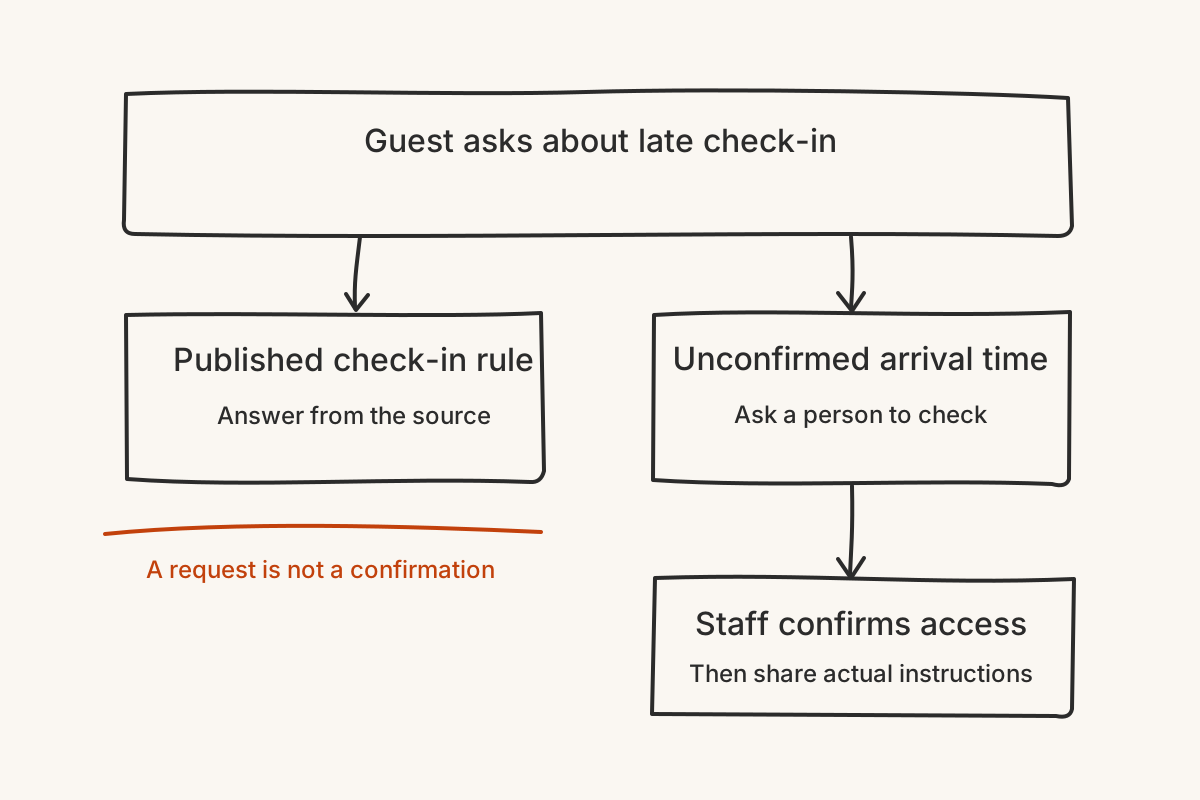
The published check-in rule answers a general question. An unconfirmed arrival time is different: staff need to check whether that guest can enter, whether anyone will be present, and what instructions can safely be shared. Staff confirms access before the guest is told what to do at the door. A request is not a confirmation.
Chatterbox answers from material the business supplies, including crawled pages, uploaded files, pasted text, and typed Q&A, and shows the source passage for an answer. If that material does not answer a specific request, it says it cannot find the answer and asks for name, phone, and email. Those details reach the dashboard and by email for human follow-up. This is not a live reservation check or a promise that someone has accepted the guest's late arrival. A traveler who needs an immediate decision should use the guesthouse's monitored route.
How can you test the FAQ before publishing it?
Ask someone outside the reception team to read the page and describe what happens if their train arrives after the normal window. Can they find the monitored contact route, the notice deadline, and the point at which staff confirms an arrangement? If not, the draft is not ready. Test a guest who has not booked yet, a guest whose arrival changes on the day, and one whose late arrival has already been explicitly approved. The answer should not flatten all three into the same promise.
If the guesthouse uses Chatterbox, ask the widget for the normal window and inspect the cited passage. Then ask whether a named guest can enter at a particular late hour without giving it any confirmed arrangement. The latter needs a person, not an invented door instruction. Keep the public FAQ and any separately supplied source material consistent when the rules change; a source can be re-crawled once a day. The useful outcome is a guest who knows exactly when to expect an answer, rather than one waiting outside because a general FAQ sounded like a personal confirmation.