An event venue overtime fee FAQ should distinguish the booked end time from the time guests must leave and the time the room must be cleared. State how extra time is requested, how it is charged, and who must confirm it. A request to stay later is not an approved extension.

An event venue overtime fee FAQ should distinguish the booked end time from the time guests must leave and the time the room must be cleared. State how extra time is requested, how it is charged, and who must confirm it. A request to stay later is not an approved extension.
Picture a host whose last song ends at the booked time while guests are still leaving and a supplier still has equipment to collect. Does that count as overtime? The answer depends on the venue's actual agreement, not on what another hall does. The wording below separates the clocks. Fill it in only after your team settles the policy; it is neither a ready-made charge nor permission to extend a booking.
When does the booked time actually end?
Write down which activity must end at the booked time. Is it music, guest access, supplier loading, or all use of the room? Then say when guests must be out and whether clearing tables and equipment falls inside the hired period. If different rooms or event types have different rules, name them beside the clock. “Venue closes at 10” can mean the bar stops serving, the event ends, or the last person leaves. These are different instructions for a host arranging transport and suppliers.
When must our event finish? Your booking covers [named room or area] from [approved start time] until [approved event end time and time zone]. Guests must [state your departure rule]. Suppliers must [state your actual clearing rule]. [Specify whether setup and cleanup are inside or outside the booked period.]
Before publishing, check the wording against the booking confirmation. An FAQ that promises longer access than the confirmation creates a dispute before the event even begins. Put any exceptions that staff can authorize in a separate sentence, rather than making the ordinary window sound flexible.
What should the overtime charge explain?
Name the trigger, the unit, and what the charge covers. Does a charge start when the event continues, when guests remain, or when suppliers are still clearing? Is it measured by an hour, part-hour, or another unit? Say whether the fee includes the room only or also staffing and other services. Use the venue's approved terms rather than a sample number. A host should not learn after the event that an advertised “extra hour” meant room access without the staff needed to keep it open.
Is there a charge if we finish late? If [your defined overtime trigger occurs], the charge is [approved amount or calculation] per [actual billing unit]. It covers [specific access or services]. [State how partial units, cleanup time and separately billed services are treated under your policy.]
If there is no settled rule for a particular supplier delay, do not guess whose bill it becomes. Tell the host how to raise it for review. Check local requirements and your actual hire terms before publishing any fee or penalty language; this is a writing framework, not legal advice.
Can a host ask for more time during the event?
A published fee is not permission to occupy the hall for longer. Another booking, building restrictions or staff availability may prevent it. Say when the host should ask, who can approve an extension, and how that approval is communicated. Do not let “overtime charged by the hour” read as “we will always stay open if you pay.”
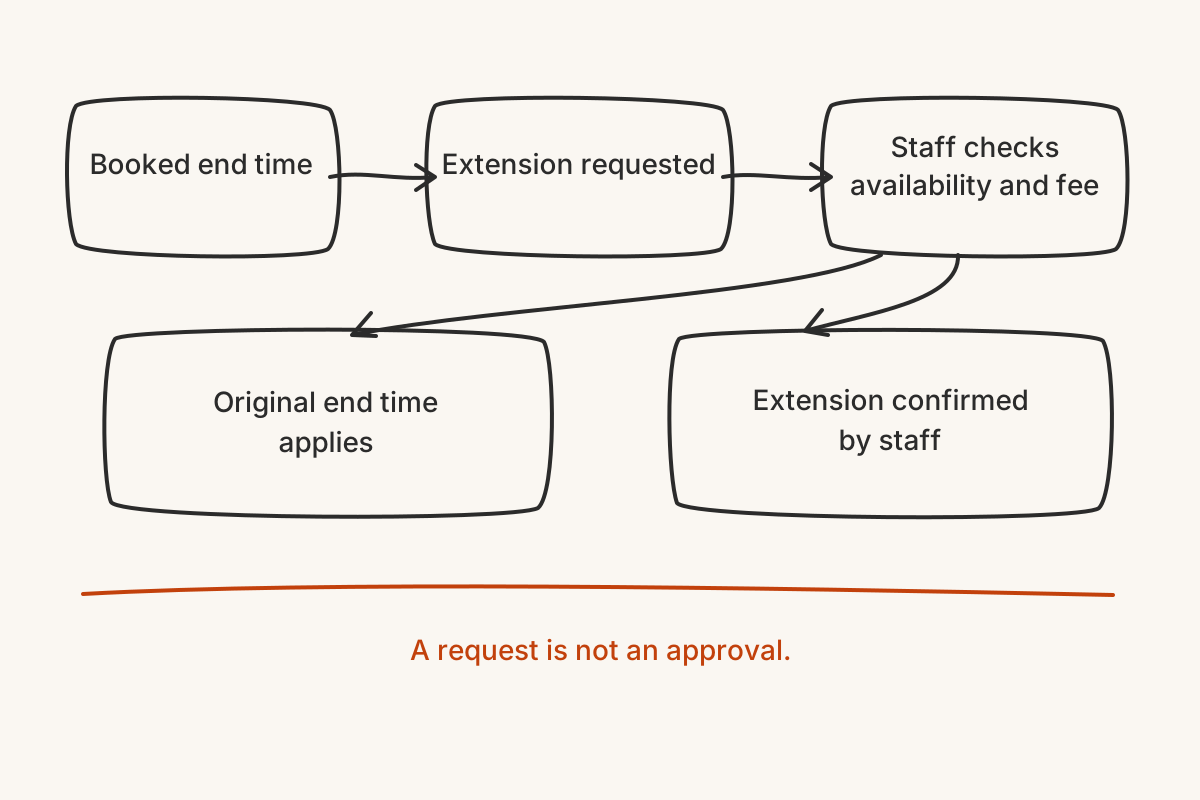
Can we extend the booking? Ask [the actual monitored contact route] by [your genuine request deadline, if any]. The team will check [the conditions it really checks] and confirm [the agreed end time and charge] through [the approval method actually used]. Until that confirmation, the original end time applies.
The decision is Booked end time → Extension requested → Staff checks availability and fee → Extension confirmed or original end time applies. A request and an approval are separate events.
Which question belongs with the venue team?
A visitor asking “What is the overtime rate?” can read a published policy if the rate and trigger are current. “Can our wedding stay until midnight next Saturday?” is about a specific date and booking. The public policy alone cannot confirm that slot. Put the ordinary rule on the website, but let staff examine the actual reservation before changing its terms. Similarly, a dispute about when a supplier left needs the venue's records, not a generic FAQ answer.
Chatterbox answers from material the business supplies and shows the source passage behind an answer. When its material does not answer a particular request, it says it cannot find the answer and asks for name, phone and email; the enquiry reaches the dashboard and by email for human follow-up. It does not approve venue time, modify a reservation or call the host. If a venue uses it, keep the FAQ and any uploaded or pasted terms aligned rather than leaving an old end time in one source.
Test the page with a routine rate question, a host asking for an extension on a named date, and a complaint about a supplier who left late. The first needs an exact rule with its billing unit. The latter two need a person with the booking details. If those questions all appear to have the same automatic answer, the FAQ is not ready for guests to rely on.