A course completion certificate FAQ should explain which course and attendance conditions qualify, who checks the learner's record, when a certificate can be collected, and how errors or missing records are handled. Publish your center's actual rules, not a blanket promise. Chatterbox can surface those rules; a person must confirm an individual learner's result.

A learner finishes the last class in a tailoring course and asks for a certificate before applying for a job. The front desk should not have to improvise an answer about attendance, assessment or timing. The website can explain the usual conditions. It cannot decide whether this learner has met them without checking the record.
Use the questions below as a framework. Replace every bracket with your training center's approved terms. Delete a question if the center does not issue that kind of document. A certificate of attendance, a course completion certificate and a qualification from an outside awarding body are not interchangeable; name exactly what your center provides.
Who qualifies for the course completion certificate?
Write the condition for each named course. Does completion mean attending a specified number of sessions, finishing practical assignments, passing an assessment, or a combination? If different batches have different rules, date the rule and identify which batch it applies to. Avoid “all students receive a certificate” if a final check is required.
Will I receive a certificate after [course name]? We issue [exact document name] when [approved completion conditions]. [State who verifies the course record.] This document is issued by [actual issuing organization].
What if I missed a session or assessment? [State the approved makeup or review route, if one exists.] Your result is confirmed after [responsible team or person] checks [the relevant record].
Do not copy the missed-class policy into this answer if the two have separate clocks. A learner may be allowed to make up a class but still need to complete an assessment before qualifying. Link to the center's actual missed-class terms and explain which condition remains outstanding.
When and how does the learner receive it?
Separate the end of instruction from the record check and the act of issuing the document. “After the last class” sounds immediate even when staff need to verify attendance. Use a date or a clearly defined interval only if your team can meet it. If the certificate is digital, printed or collected in person, describe only the method you actually use.
When will it be ready? After [record verification event], [team] will [approved notification or collection method] within [approved time frame].
What should I bring or provide? To collect or request the document, provide [approved identifier or proof] through [your actual channel]. [State how someone else may collect it, if allowed.]
Do not ask a visitor to put sensitive identity documents into a public chat. Give a secure or in-person route your center has approved. If a third party issues the certificate, distinguish your center's record check from that organization's own process rather than promising a delivery date you do not control.
Who checks a correction or a missing record?
A name spelled differently in the enrollment record and on an identity document needs a person to reconcile it. So does a practical assessment recorded on paper but absent from the course system. Publish a route for both cases without declaring the learner eligible merely because they say the work was done.
My name is wrong or my certificate has not arrived. What do I do? Contact [named team and monitored channel] with [minimum reference details]. We will check [records and correction process] and tell you [how the outcome is confirmed].
Can I get a replacement? [State whether replacements are available, any verified fee, and the method for confirming the original issue.]
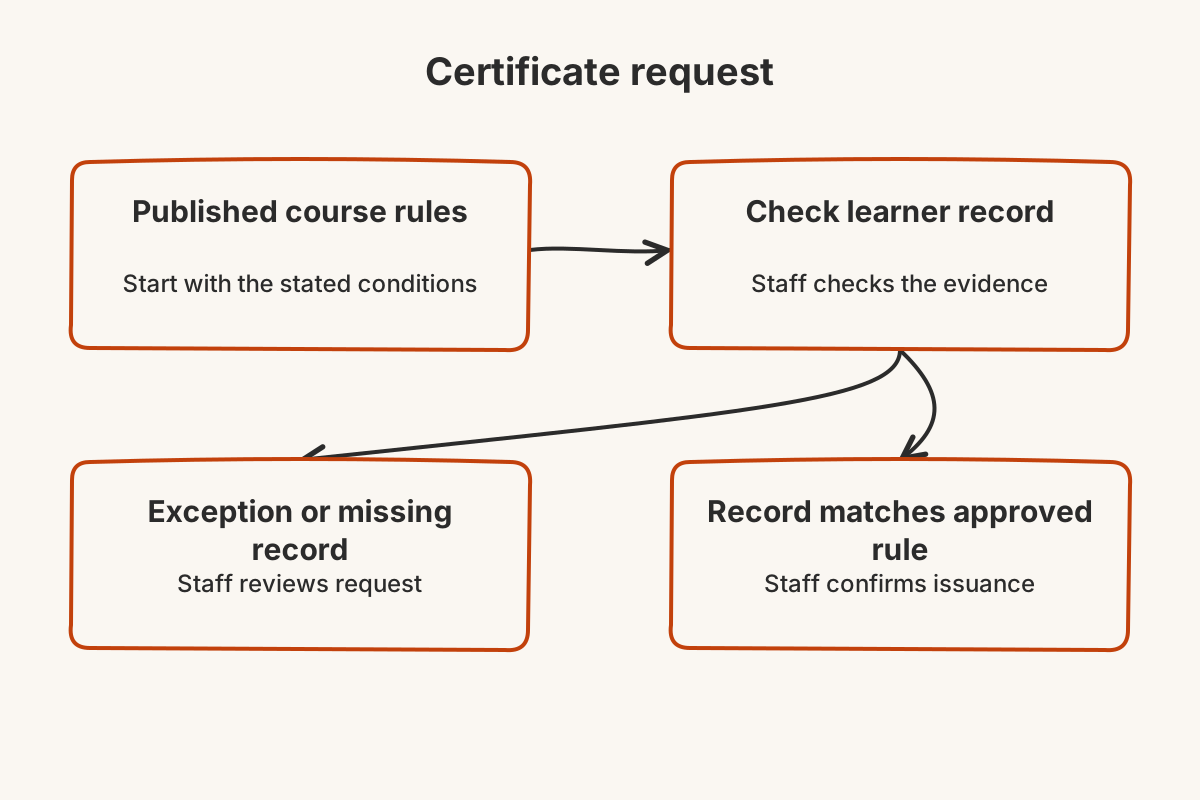
The path is simple: published course rules, then a learner record check, then staff confirmation. An exception or missing record goes to staff for review. The diagram does not imply the website issues or verifies certificates itself.
How do you stop a certificate enquiry becoming a false promise?
Try three enquiries at your own reception desk. One learner has attended every class but the assessment sheet has not been signed. Another has passed but needs a different spelling on the document. A third asks whether an outside employer will accept the certificate. None can be settled by a generic line saying “certificates are available.” The first needs the assessment record, the second needs a correction procedure, and the third is a decision for the employer. Add those limits to the FAQ instead of offering reassurance the center cannot verify.
Chatterbox can repeat the published completion rule and display its source passage. It cannot check the learner's file or issue a credential. When the material has no answer for a particular case, it says it cannot find one and requests contact details. Name, phone and email reach the dashboard and arrive by email, leaving staff to investigate. Do not turn a handoff into a promise that the certificate will be ready by tomorrow.
Ask the widget, “Does finishing this batch guarantee my certificate?” Compare the displayed source to the actual rule. Then try “My final practical result is missing” and “Can you change the name on my certificate?” If a reply treats those as settled outcomes, tighten the source language and test again. Keep the certificate page separate from enrollment requirements and from a general missed-class notice: qualifying to join, attending lessons, and being issued a document are three different events. Retire outdated copies when your rules change; a source can be re-crawled once a day.