A tuition center batch change policy FAQ should say how a family requests a permanent move, what the center checks before agreeing, when the new schedule begins, and who confirms it. A request is not a seat in another batch. Publish your real rules, and leave each student's availability and level check to staff.

Imagine Monday's attendance register already printed. The child enrolled in that math group wants Wednesdays for the remaining term. A casual “yes, Wednesday has space” can leave Monday's teacher counting an absent child and Wednesday's teacher facing one they never agreed to teach. This template is about exchanging a recurring place, with a clear end date for the first commitment and start date for the second.
Treat the two dates as a pair. Without them, changing a row in one register may silently create either a gap or double booking. The parent should have one clear instruction about where to attend until the exchange is approved.
What does a parent need to specify about the proposed move?
Start with the child's current subject, level and regular day. Then ask for a preferred new day and the date from which the change is wanted. A family may be able to do Wednesday at the same time but not Friday at all. Let them rank workable alternatives instead of treating an empty slot as permission to assign any day.
Set one route for making this request. If a parent speaks to the teacher on the way out, can that teacher approve a permanent change or only pass it to reception? Put that boundary in the FAQ. Personal student information should go through the center's own private route, not into public website copy. An acknowledgement means staff received the question; it is not the revised timetable.
What should the batch change FAQ say?
Adapt this parent-facing block after the center agrees on a channel, a decision owner and the treatment of any sessions already paid for:
Changing a regular class: Our current [subject/level] group meets [weekday/time]. To request [preferred new group], contact [route] and give [student reference], [preferred weekday] and [desired first date]. Stay with the current group until [role] sends you a new schedule. We check both a continuing seat and the right teaching level. If approved, your last old-group lesson is [date] and your first new-group lesson is [date]. [Explain any fee or materials adjustment.] If that group will not work, [explain the alternative enquiry route].
Keep the brackets visible in the draft, not in the published FAQ. In particular, one date without the other makes a gap or an overlap possible. Staff fill these dates only in an individual confirmation; the public version explains the steps rather than containing a student's completed timetable.
Who confirms a permanent move, and what happens to the old seat?
The center needs a single effective-date note, not two independent edits to a spreadsheet. In the example above, the receiving teacher accepts the Wednesday arrangement, the Monday register is closed for that child on a named date, and the family receives one message showing both dates. If Wednesday starts a week later, somebody must explain what the child attends in between.
The note can be this short:
Approved. Last Monday math lesson: 9 November. First Wednesday math lesson: 11 November. Please collect the Wednesday worksheets from reception on the 11th.
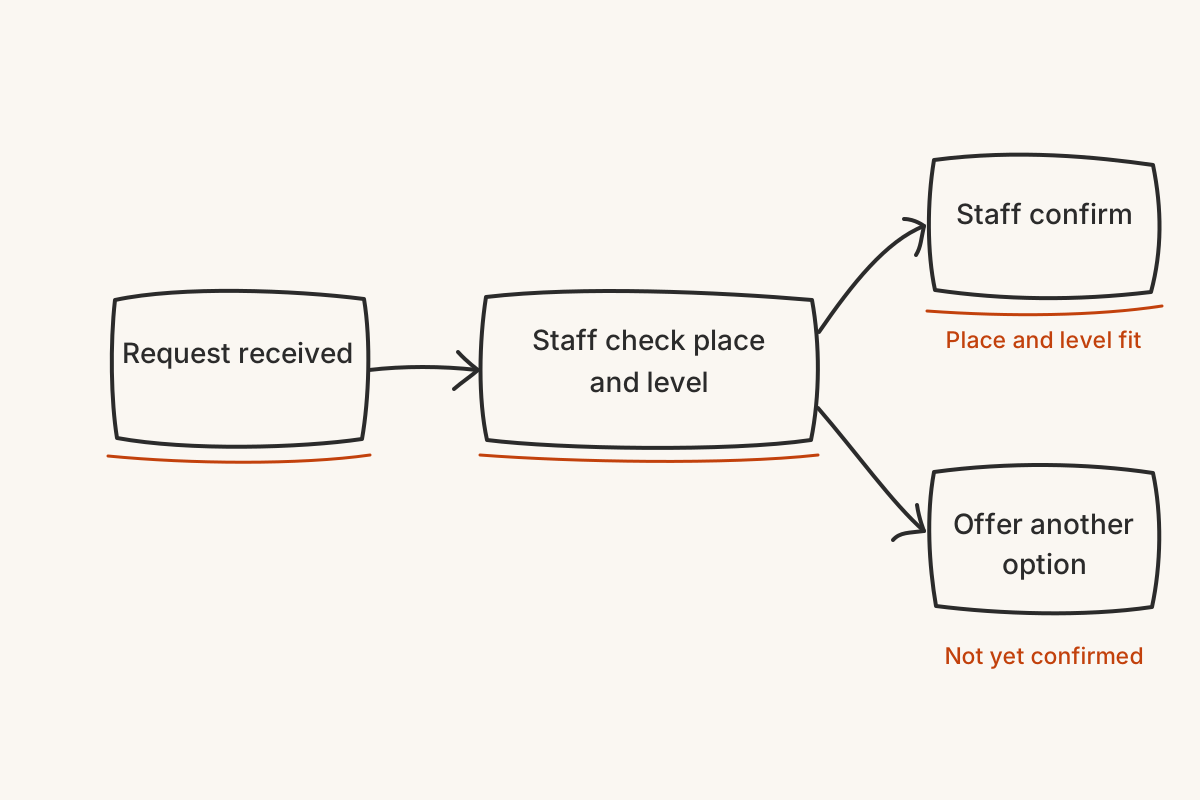
The figure draws that fork: a request travels through a staff check before it becomes a changed timetable.
What if Wednesday looks free but covers a later chapter? The center may decline this move without declining every possible move. What if the family only accepts Wednesday and Thursday is open? Thursday is an offer, not an enrollment. If the center charges differently for the new group, work out how already paid sessions are treated before sending the effective-date note. A switch from a 60-minute to a 90-minute class may change the monthly charge, and a midterm exchange can strand unused lessons. Reconcile both against the billing ledger, and never quote a balance from the public FAQ. A full-class waitlist concerns a future vacancy; a missed-lesson makeup concerns one absence. Neither document decides a permanent change to a child's regular attendance.
What can a website chatbot answer about a batch change?
The public process fits in one paragraph: where to request a new recurring slot, who weighs the classroom roster against the child's level, and how two effective dates are issued. Chatterbox can use a crawled page, file upload, pasted text or hand-typed Q&A, and show the source passage supporting that process. An evening visitor can learn which door to knock on without mistaking an unreviewed vacancy for admission.
“Is my daughter already on Wednesday's register?” is not a public-process question. Chatterbox cannot establish that from the general instructions. If the supplied material has no answer, it says so and asks for name, phone and email; the lead reaches the dashboard and by email. A staff member must inspect the actual roster and answer. The widget cannot change enrollment.
Rehearse one discrepancy: Monday's teacher expects the child next week; Wednesday's teacher expects her tomorrow. Which effective-date note controls? Reception should be able to find the last Monday session and the first Wednesday session in one approval. If it cannot, rewrite the handover and test again before announcing a new schedule.