A bakery preorder cutoff FAQ should name the eligible bakes, the exact request deadline, the calendar rule behind it, and the point at which staff confirm availability. Separate routine orders from holiday and late requests. A visitor who meets the deadline has asked in time; they have not reserved a bake until the bakery says yes.

A customer wants a dozen croissants for Friday morning. The bakery's menu says “preorder the day before.” Does a Thursday evening message qualify? Does the kitchen make twelve extra croissants on request? Those are different questions. This worksheet helps a bakery publish its actual ordering clock while leaving production capacity and acceptance to the bakers. Replace bracketed fields before putting any answer online.
Which bakes follow the regular ordering clock?
Make a small menu of eligible bakes rather than one universal deadline. A standard pastry box might be prepared in batches; an iced celebration cake may need an agreed design and a separate schedule. Mark the boundary in product names a customer recognizes. If size or quantity changes the preparation window, say which combinations use which clock.
For every listed bake, the ordering clock needs four coordinates: product, desired collection date, latest request time, and time zone. Write whether the deadline falls on the preceding calendar day or on a preceding day when the bakery is open. For a Sunday collection, for example, “one working day before” is ambiguous unless the bakery states which days count. This is an illustration of a wording problem, not a suggested Sunday service or cutoff.
Use a real inbox or order-taking route and explain how the customer will know the kitchen has accepted the request. A sent message is evidence of a request, not a tray set aside on the rack. A deadline tells the customer when to ask; it cannot tell them how much dough the kitchen has made or whether a pickup window is full.
What preorder FAQ wording can you copy?
Use these questions as slots for the bakery's actual policy. Keep each answer close to the item it covers. Delete any question for which the team has no agreed process.
When must I preorder [standard item]? To request [named item] for [collection or delivery day], send your request by [time and local time zone] on [day or rule for counting working days]. This is the request deadline, not a promise of availability.
When is my order confirmed? Your request is confirmed only when [describe the actual confirmation method and responsible team]. If you have not received confirmation by [the bakery's real follow-up instruction], contact [approved route] before making collection plans.
Do weekends and holidays change the deadline? [State which days count in the lead time and any separately approved holiday cutoff.] If special dates have no fixed rule, ask customers to check with the team rather than treating the ordinary cutoff as valid.
Can I order after the cutoff? [State whether the bakery considers late requests and how to ask.] A request sent after the deadline is not accepted until a person confirms it. Do not publish “we can usually fit you in” unless the team intends that as a real promise.
What if I need a custom item or a larger quantity? [Say what information the bakery needs before it can decide.] Give a separate review route. A standard-item deadline should not silently extend to an unquoted custom order.
Does a request before the deadline guarantee the order?
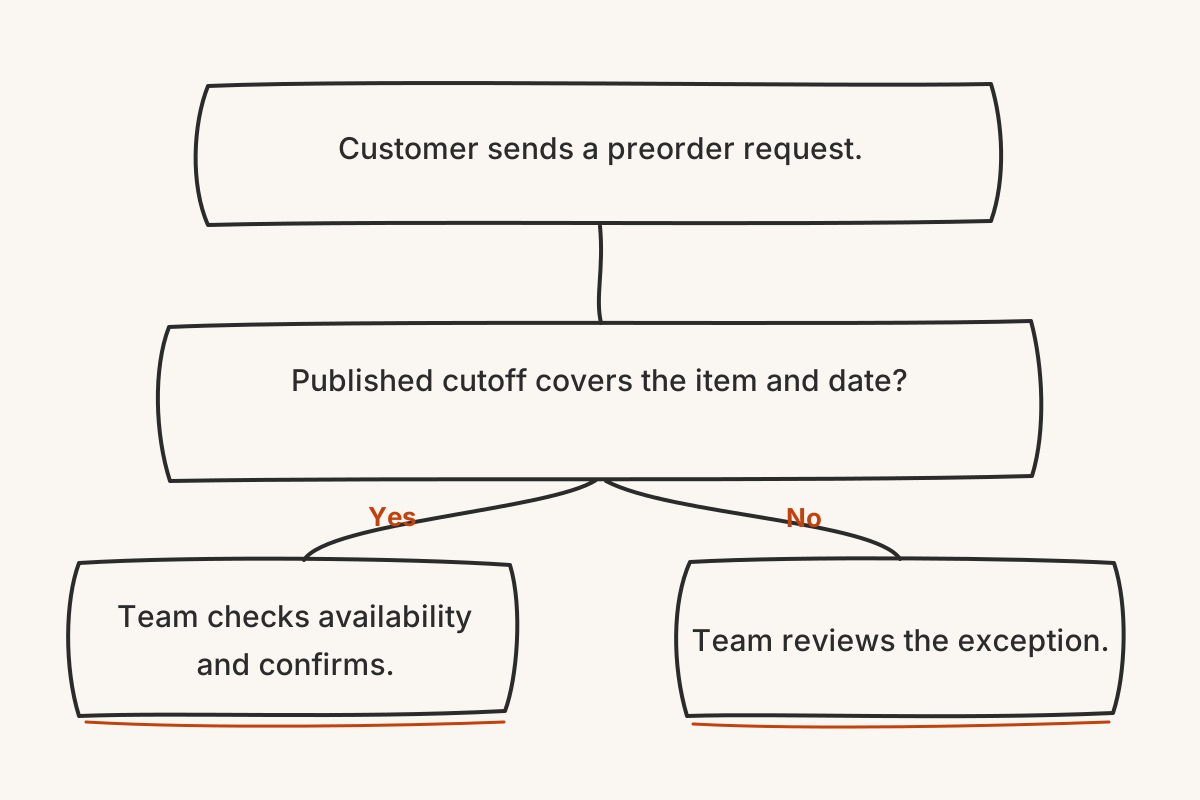
No. The useful path is Customer sends a preorder request. Published cutoff covers the item and date? If yes, Team checks availability and confirms. If no, Team reviews the exception. Both paths require a person to confirm the order. A published deadline tells the customer when to ask; it does not inspect the bakery's capacity or reserve a slot.
Chatterbox answers from the business's own material and shows the passage behind an answer. If the material does not settle an after-cutoff request, it says it cannot find the answer and asks for name, phone and email. That enquiry reaches the dashboard and by email for a person to review. Chatterbox does not inspect live production capacity or accept an order on the bakery's behalf. Keep “request received” separate from “order confirmed” in both your FAQ and the team's actual replies.
How should you test a published cutoff?
Try the rule with three customers: one asks early for a standard item, one asks just after the stated time, and one wants a custom item on a holiday. Can each tell which deadline applies, what to send and whether anyone has accepted the request? If two staff members calculate different cutoff dates, rewrite the rule before you publish it.
Read the site answer beside the bakery's current order-taking practice. Chatterbox can use site crawls, uploaded files, pasted text and hand-typed Q&A; do not leave an old cutoff in one source while replacing it in another. A website source can be re-crawled once a day. After any change to hours or ordering policy, refresh the source and retest all three requests. The test succeeds only when the routine question gets a clear deadline and the exception goes to the team without an invented yes.